What Argostoli is like
Argostoli has been the island's capital since 1757, when it replaced the hilltop town of Agios Georgios (Kastro) to make the most of its sheltered bay. Around 11,000 people live in the town itself – by far the largest place on Kefalonia and the only one that feels like a town all year round.
Almost nothing is very old. The 1953 earthquake, whose main shock struck on 12 August after two strong foreshocks, levelled nearly every building on the island except around Fiskardo, and Argostoli was rebuilt in the years that followed. The result is a grid of low, pastel-coloured blocks around a big central square and a long waterfront facing the bay. It is busy, practical and very Greek, with banks, the hospital, the bus station and shops locals actually use.
Things to do in Argostoli
The heart of town is Vallianos Square, a wide paved square lined with cafés where Argostoli comes out for its evening walk. From there the Lithostroto, the pedestrian shopping street, runs for about 800 m to Kampana Square, named after its bell tower; the tower collapsed in 1953, but the bell was found intact and put back when it was rebuilt. Next to the Catholic church of St Nicholas on the Lithostroto, a small exhibition remembers the Italian Acqui Division, thousands of whose soldiers were killed by German forces on Kefalonia in September 1943.
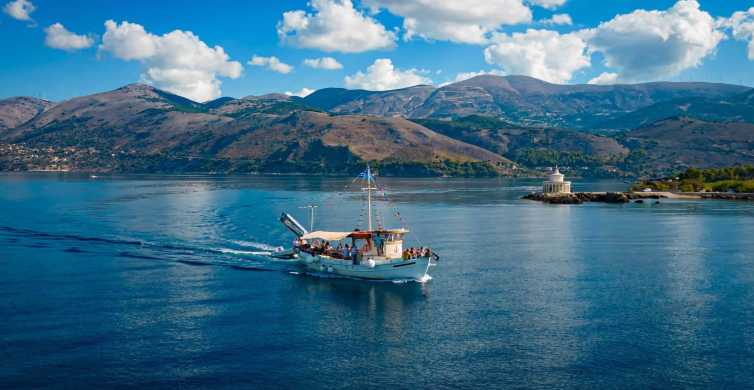
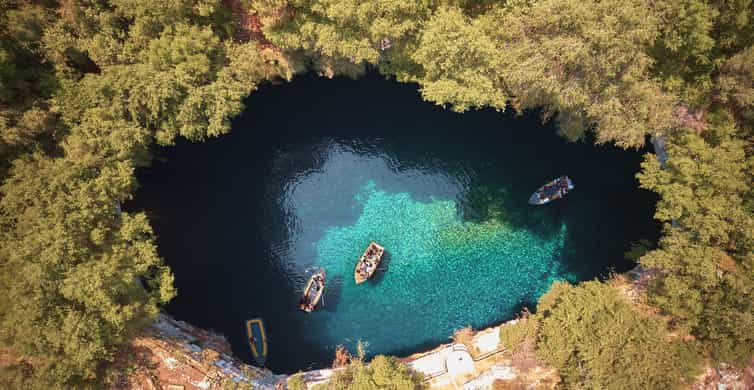
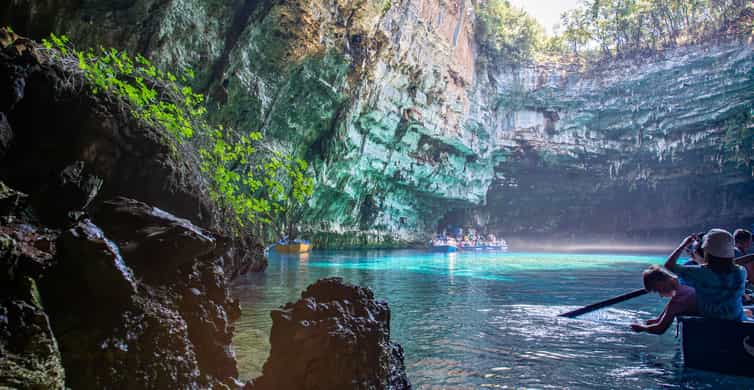
Walk north along the waterfront to the headland and you reach the Katavothres, sinkholes where the sea flows into the rock. Dye tests in 1963 showed the water travels under the island and emerges near Sami, passing through the lake of Melissani Cave. A little further on, the Doric-columned Agios Theodoros lighthouse, first built under British rule in 1829 and reconstructed after the earthquake, is the classic sunset viewpoint.
Two museums are worth an hour. The Korgialenios Historical and Folklore Museum, which shares a building with the Korgialenios Library, shows how Argostoli lived before 1953 through costumes, furniture and photographs. The Focas-Cosmetatos Foundation near the main square displays paintings, lithographs and Ionian banknotes, and runs the Cephalonia Botanica garden on the edge of town. The Archaeological Museum has been closed since the 2014 earthquakes; its interior is to be rebuilt, but no reopening date has been announced. Opening hours change by season, so check before you go.
The De Bosset (Drapano) bridge
The stone causeway that crosses the Koutavos lagoon at the southern end of the waterfront is the De Bosset bridge, known locally as the Drapano bridge. Charles Philippe de Bosset, the Swiss-born officer who governed the island under British protection, had a wooden bridge built here in 1813; it was later rebuilt in stone on low arches. At about 690 m it is often described as the longest stone bridge over the sea.
Part of it collapsed in 1953, and it was later closed to traffic. Since a restoration finished in 2013 it has been a footbridge, with replica lanterns and a British-era obelisk halfway across. Walking over it gives the best view back to town and, on calm mornings, a good chance of spotting turtles.
The loggerhead turtles of Argostoli harbour
Argostoli is one of the few places in the Mediterranean where you can watch wild sea turtles from a town pavement. Loggerheads (Caretta caretta) feed in the sheltered waters of the harbour and the Koutavos lagoon; the conservation group Wildlife Sense has counted more than 100 in the bay at once in April and May, and identified over 360 individual turtles in a year. Look for them along the harbour wall in the morning, when the fishing boats come in, and from the De Bosset bridge.
Some fishermen and visitors throw scraps to them, which teaches the turtles to approach people and boats and leads to fights over food. Please do not feed or touch them, keep your distance if you swim or kayak, and avoid boat trips that lure turtles with fish. Read more in our guide to the turtles of Argostoli.
Argostoli beaches and Lassi
Argostoli has no beach in the centre, as the town faces an inner bay. The nearest sand is 2–3 km south in Lassi, where Makris Gialos and Platis Gialos are the busy, organised beaches most people mean by Argostoli beach. It is a walk of about half an hour, or a short taxi ride.
For quieter water, drive 30–40 minutes to Myrtos or south-east to Lourdas, or cross to Paliki on the ferry for Xi and Petani beaches. Our guide to Kefalonia's beaches compares them all.
Eating, evenings and the ferry to Lixouri
Argostoli has the best choice of food on the island because it cooks for residents as well as visitors: grills and tavernas on the streets behind Vallianos Square, fish restaurants on the waterfront, bakeries and cafés on the Lithostroto. Try Kefalonian meat pie (kreatopita) with a glass of Robola, the island's white wine. Prices are generally fairer than in Fiskardo or Assos.
Car ferries to Lixouri leave from the waterfront every 30 to 60 minutes from early morning to late evening, according to Ionian Sea Ferries, and the crossing takes roughly 20 to 30 minutes. Tickets are sold on board. It makes an easy half-day trip without a car.
Staying in Argostoli, getting there and parking
Argostoli suits travellers without a car, people visiting outside summer and anyone who prefers a town to a resort. It is the hub of the KTEL bus network, the airport is about 15 minutes away, and restaurants are on your doorstep. The trade-off is that every beach day starts with a bus, taxi or short drive, and hotels are mostly simple city hotels; for a pool and sand, stay in Lassi. Compare the options in where to stay in Kefalonia.
From the airport, a KTEL bus runs to Argostoli in summer only; otherwise take a taxi from the rank outside the terminal. If you drive, street parking near the waterfront fills up quickly in July and August, so park on the outer streets and walk in. If you plan to explore, see car hire in Kefalonia and the tours from Argostoli.