What Skala in Kefalonia is like
Skala sits where Kefalonia's south-east coast looks across the sea towards the Peloponnese. The village you see today is young. The old village stood on the hill behind, a common choice on the island as protection against pirates, and it was levelled by the earthquake of August 1953; the new Skala was built from 1956 on flatter ground closer to the sea.
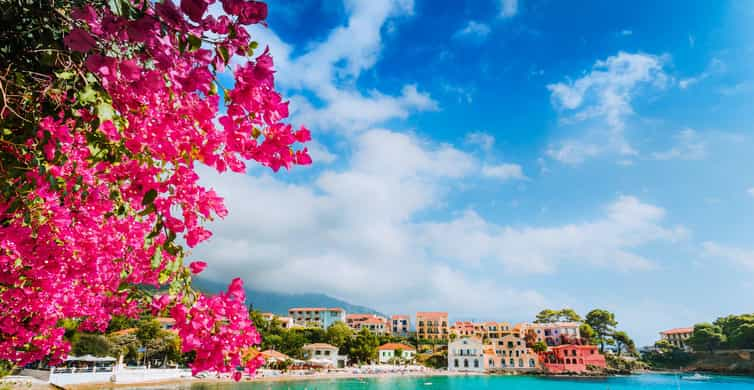
The result is one of Kefalonia's main package resorts, especially popular with British families: a straight main street of tavernas, bars, supermarkets and car hire offices, with apartments, small hotels and gardens spreading down towards the beach. It is livelier than Katelios or Poros, but far less built-up than the resort strip at Lassi near Argostoli.
Skala beach
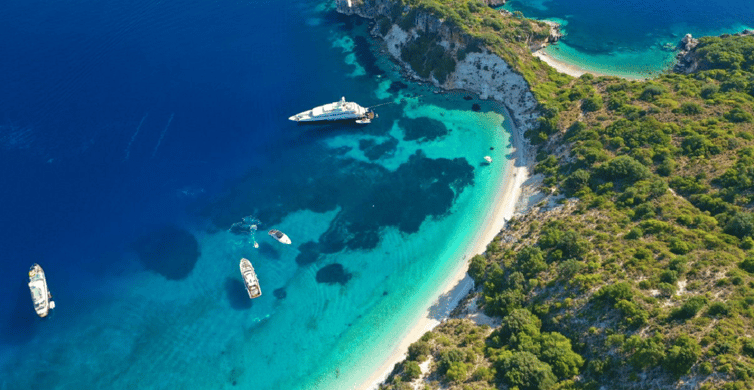
Skala beach is the reason most people come. It runs for a long way south of the village: a broad strip of sand with fine shingle along the waterline and pine trees behind it in places. Near the village it is organised, with sunbeds, umbrellas, beach bars and watersports in summer; walk further south and the sunbeds thin out and you can usually find space even in August.
Because it faces east, the beach gets the morning sun and is often calmer than the west coast when the summer north-westerly picks up in the afternoon. Bring water shoes if you dislike shingle underfoot. For other beaches in the south, from Mounda near Katelios to the sandy bays under Mount Ainos at Lourdas, see our guide to Kefalonia's beaches.
The Roman villa and other things to do in Skala
On the edge of the village, the Roman villa of Skala is one of the few ancient sites on the island that is easy to visit. The remains were found by chance in 1944 and excavated from 1957. A shelter and a walkway protect several mosaic floors: the best known shows Envy as a young man attacked by four big cats, with a Greek verse inscription that names a certain Krateros, and another shows a sacrifice, with a bull, a ram and a boar led to an altar. The villa was probably destroyed by fire in the 4th century AD, and an early Christian church was later built over part of it. Entry has traditionally been free.
A few kilometres north, on the road to Poros, are the scant remains of an archaic Doric temple, often linked to Apollo: foundations and pieces of columns in an olive grove, worth a short stop rather than a special trip.
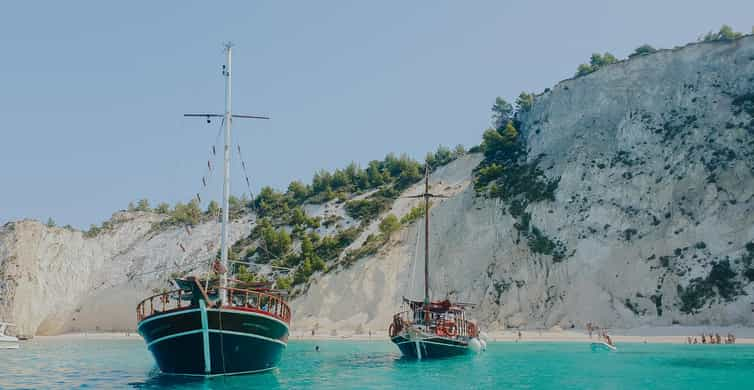
For a walk, follow the lanes up to Old Skala on the hill behind the resort, where the ruins of houses, churches and wells left after 1953 stand among the trees; go early or late in summer, as there is little shade. In season, day cruises to Ithaca leave from Skala and nearby Poros; see boat trips and boat hire for the options and what to check before you book.
Turtles on Skala beach: how to behave
Loggerhead turtles (Caretta caretta) nest on Skala beach and on the neighbouring bay of Mounda. The conservation group Wildlife Sense runs a field station in Skala: in 2026 its volunteers protected and relocated nests here and mapped the sea floor around Skala and Mounda. Females come ashore at night from about late May to mid-August, the eggs incubate for 45 to 60 days, and hatchlings emerge from about July to October.
Nests are marked with signs and a contact number. Keep out of marked areas and never move the signs or cages. Before you leave the beach, knock down sandcastles and fill in holes, which can trap hatchlings. Avoid torches and phone lights on the sand after dark, and if your room faces the sea, close the blinds at night, as artificial light can lead hatchlings inland instead of towards the water.
If you see a turtle on the beach or in the sea, keep well back, stay quiet and do not touch, feed or follow it. Choose boat trips that keep their distance rather than luring turtles with fish. More on the island's turtles, including those in Argostoli harbour, in our turtle guide.
Eating and evenings in Skala
Skala has more choice than any other village in the south-east. Tavernas along the main street and near the beach serve the Greek standards, grilled meat and fish, and sometimes island specialities such as kreatopita, Kefalonian meat pie; there are cafés, bakeries and cocktail bars for the evenings. Nightlife means busy bars and music until late in July and August, not clubs.
For fresh fish by a harbour, drive 15 minutes west to the tavernas of Katelios. In May and October some places run shorter hours, and most close for the winter.
Staying in Skala: who it suits
Skala suits families and anyone who mainly wants a beach holiday with restaurants within walking distance. The village is flat, the beach is close to most apartments and you can manage a week without a car, filling the gaps with organised tours.
The trade-off is distance. Skala is at the far end of the island from the headline sights: Myrtos is about 55 km away, well over an hour's drive, and Fiskardo is further still. If you plan to tour the island every day, a central base such as Sami or Argostoli saves hours; compare them in where to stay in Kefalonia. In August the resort is full, so book early, and check the best time to visit if you prefer quieter months.
Getting to Skala and parking
From the airport or from Argostoli, Skala is about 40 km away, roughly 45 minutes to an hour by car on winding roads; a taxi or pre-booked transfer is the easiest option on arrival. KTEL buses link Skala with Argostoli only a few times a day, so a hire car for at least part of your stay makes day trips far easier.
Poros, the port for ferries to Kyllini on the mainland, is about 12 km north. Parking is mostly on the street; spaces near the beach fill by late morning in summer, so walk if you can.